Introduction
Businesses today generate an enormous amount of data every day — customer conversations, sales orders, invoices, emails, support tickets, documents, products, employees, and countless other records.
The challenge is no longer simply managing data. The real challenge is turning that data into meaningful actions, faster decisions, and better business outcomes.
This is where Odoo AI is changing the way businesses work.
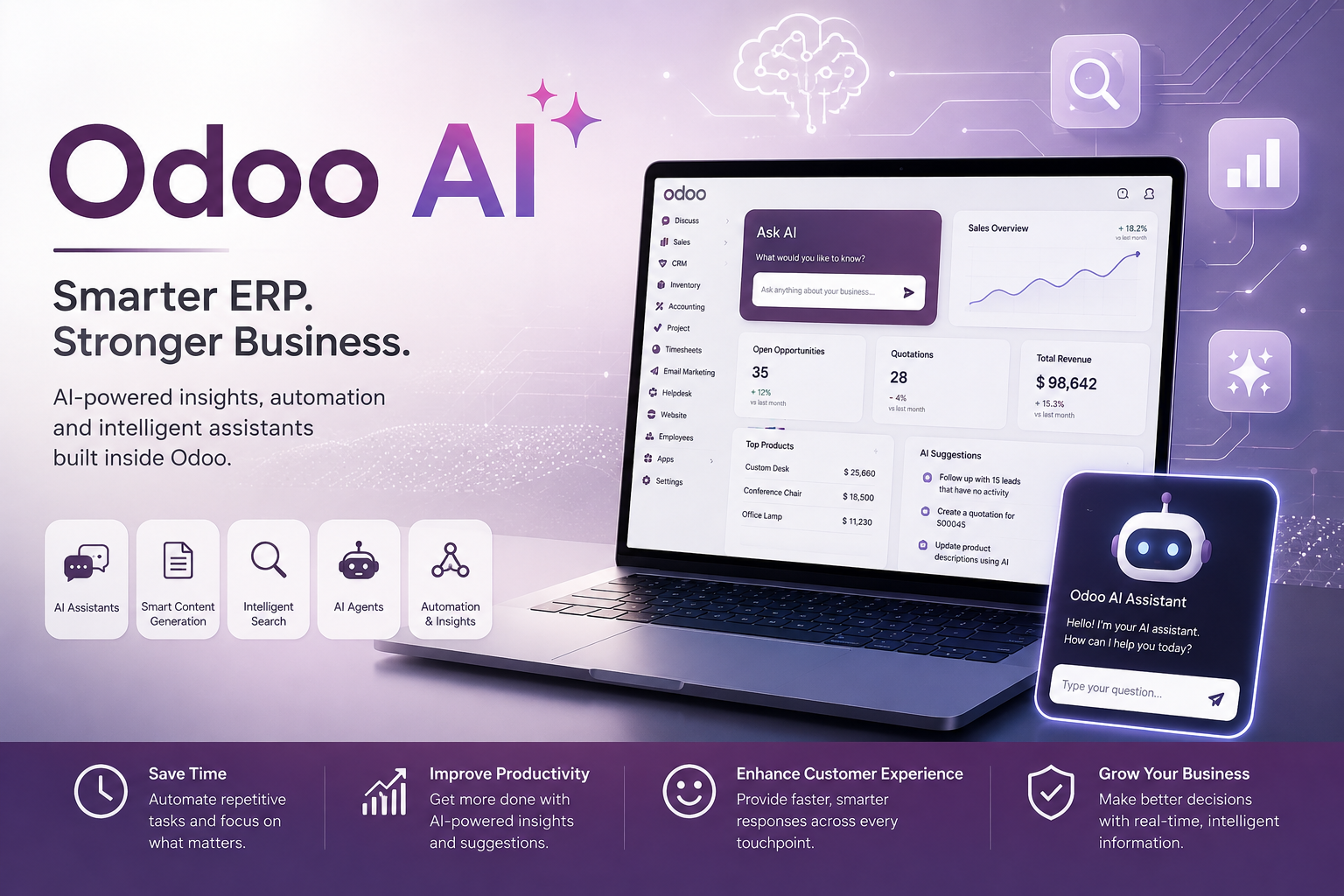
By bringing Artificial Intelligence directly into the Odoo ecosystem, businesses can move beyond traditional ERP workflows and create a smarter working environment where employees can ask questions in natural language, generate content, summarize information, access company knowledge, automate repetitive activities, and work with AI-powered assistants.
Odoo AI is not simply another chatbot.
It represents a shift toward an intelligent ERP — one that can understand business context and assist people in getting work done.
What Is Odoo AI?
Odoo AI is a set of artificial intelligence capabilities integrated into the Odoo platform.
Instead of employees constantly searching through menus, records, documents, and conversations, AI can help them interact with Odoo using natural language.
For example, instead of manually searching through the CRM, a salesperson could ask:
“Show me the opportunities that are likely to close this month.”
Instead of spending time writing a customer response, an employee could ask:
“Draft a professional follow-up email for this customer.”
Instead of searching through multiple internal documents, an employee could ask:
“What is our company’s refund policy?”
The objective is simple:
Make business information easier to access, understand, and act upon.
Why AI in ERP Matters
ERP systems are the central nervous system of many organizations.
They contain critical information about:
- Customers
- Sales
- Products
- Inventory
- Accounting
- Purchases
- Employees
- Projects
- Helpdesk
- Documents
- Website activity
However, having information in an ERP does not automatically mean employees can use it efficiently.
Employees still spend significant amounts of time:
- Searching for information
- Reading long conversations
- Writing repetitive emails
- Preparing summaries
- Classifying information
- Creating descriptions
- Answering repetitive questions
- Performing routine tasks
AI can reduce much of this manual effort.
The combination of ERP + AI + Automation creates a powerful new approach to business management.
Odoo AI: From ERP to Intelligent ERP
Traditional ERP systems primarily help businesses record, organize, and process information.
AI-powered ERP systems can go one step further.
They can help businesses:
Understand information → Generate insights → Recommend actions → Automate selected tasks
This changes the role of ERP from being simply a system of record to becoming a business productivity platform.
Odoo’s AI capabilities include AI assistants, AI agents, AI-powered fields, natural-language interactions, content generation, document-based knowledge, and AI-enabled automation.
Key Odoo AI Capabilities
1. Ask AI — Interact With Odoo Naturally
One of the most intuitive ways to use AI in Odoo is through natural-language interaction.
Users do not always need to remember where a particular function is located.
They can simply describe what they need.
For example:
“Find my open sales opportunities.”
“Summarize this conversation.”
“Improve this email.”
“Explain this information.”
This makes Odoo more accessible and can reduce the time employees spend navigating through the system.
2. AI Agents — Your Digital Business Assistants
AI Agents take the concept of AI assistance to another level.
An AI Agent can be designed for a particular role or business process.
For example, an organization could create:
Sales AI Agent
Designed to help sales teams manage opportunities, prepare communications, and retrieve relevant customer information.
Customer Support AI Agent
Designed to assist support teams with customer questions, ticket summaries, and knowledge retrieval.
HR AI Agent
Designed to help employees find information from approved HR policies and internal documentation.
Product AI Agent
Designed to help employees retrieve product specifications, features, manuals, and other product information.
This means businesses can build specialized AI assistants around their own processes and knowledge.
3. AI-Powered Knowledge Management
Every organization has valuable knowledge.
It may be stored in:
- PDFs
- Company policies
- Product manuals
- SOPs
- Internal documentation
- Knowledge articles
- Training materials
- Website content
Finding the right information can sometimes take minutes — or even longer.
With AI-powered knowledge capabilities, employees can interact with business information more naturally.
Imagine an employee asking:
“What is the process for handling a damaged product returned by a customer?”
Instead of manually searching through multiple documents, an AI assistant can help locate and present the relevant information.
This can transform the way organizations manage and share internal knowledge.
4. AI-Powered Email and Content Generation
Business communication consumes a considerable amount of employee time.
Salespeople write follow-ups.
Support teams respond to customers.
Marketing teams create content.
Managers prepare internal communications.
Odoo AI can assist with generating and improving business content.
For example:
“Write a professional follow-up email after sending this quotation.”
Or:
“Rewrite this message in a more professional and customer-friendly tone.”
AI can provide a starting point that employees can review, edit, and approve.
This doesn’t remove the human element.
Instead, it helps employees spend less time staring at a blank screen and more time focusing on the customer.
5. AI Fields — Turn Business Data Into Useful Information
AI can also be integrated into Odoo fields.
For example, a business may maintain a large number of products and want a concise product summary for each one.
An AI-powered field can assist in generating information based on the available record context.
Possible applications include:
- Product summaries
- Customer summaries
- Descriptions
- Classifications
- Internal notes
- Business insights
This can be particularly valuable for organizations dealing with large volumes of records.
6. AI-Powered Customer Support
Customer expectations have changed.
Customers want quick, accurate, and personalized responses.
Support teams, however, may be handling hundreds or thousands of tickets.
AI can act as a powerful support assistant.
It can help with:
Understanding
Analyze the customer’s message and identify the main issue.
Summarizing
Convert lengthy conversations into concise summaries.
Knowledge Retrieval
Find relevant information from approved company documentation.
Response Generation
Prepare a suggested response for the support representative.
Escalation
Identify situations that require human intervention.
The result is a support team that can work faster without sacrificing human oversight.
7. AI and Sales
Sales teams are constantly dealing with information.
A single opportunity may include:
- Customer details
- Emails
- Internal notes
- Meetings
- Quotations
- Products
- Sales activities
- Previous interactions
AI can help salespeople quickly understand the current situation.
A salesperson could ask:
“Summarize this opportunity and suggest the next steps.”
Instead of manually reviewing every interaction, the salesperson receives an AI-generated starting point.
AI can also assist with:
- Follow-up emails
- Customer communication
- Opportunity summaries
- Lead qualification
- Product information
- Sales content
This allows salespeople to spend more time selling and building relationships rather than performing administrative work.
8. AI for Marketing
Marketing teams constantly create content.
From product descriptions to website pages and promotional campaigns, content creation can consume significant time.
Odoo AI can help marketing teams accelerate this process.
It can assist with:
- Blog ideas
- Product descriptions
- Website content
- Marketing copy
- Email campaigns
- Social media content
- Content improvement
AI-generated content should always be reviewed by the marketing team, but it can dramatically reduce the time required to produce the initial draft.
9. AI + Automation
The real potential of AI appears when it is combined with automation.
Traditional automation follows predefined rules:
IF this happens → THEN do this.
AI can introduce an additional layer of interpretation.
For example:
A customer sends a complex support request.
Instead of relying only on fixed keywords, AI can help understand the customer’s message and determine the appropriate action.
The workflow can become:
Customer Message → AI Understanding → Business Rule → Odoo Action
This opens the door to more intelligent business workflows.
10. AI in Live Chat
Live Chat is often the first interaction between a potential customer and a business.
An AI-powered assistant can help businesses provide immediate responses while also supporting lead-generation processes.
For example:
Website Visitor
↓
AI Conversation
↓
Requirement Identification
↓
Lead Qualification
↓
CRM Lead
↓
Sales Team Follow-Up
This creates a seamless connection between website engagement and the CRM.
11. AI for Documents and Business Knowledge
Businesses deal with large amounts of documentation.
Contracts, manuals, policies, procedures, and technical documents can become difficult to search manually.
AI can help employees interact with this information using natural language.
Instead of asking:
“Where is the document that contains our warranty terms?”
an employee can ask:
“What does our warranty policy say about products returned within 30 days?”
The AI can help identify relevant information from approved sources.
This can make organizational knowledge significantly more accessible.
Real-World Odoo AI Use Cases
The possibilities become clearer when we look at practical examples.
Use Case 1: Sales Follow-Up
Traditional Process
Salesperson checks the opportunity → reads emails → reviews notes → writes an email → sends it.
AI-Assisted Process
Salesperson asks AI to summarize the opportunity and draft a follow-up → reviews the draft → sends it.
Result: Less administrative work and faster customer communication.
Use Case 2: Customer Support
Traditional Process
Support agent reads a long ticket → searches documentation → prepares response.
AI-Assisted Process
AI summarizes the ticket → retrieves relevant knowledge → prepares a suggested response → support agent reviews and responds.
Result: Faster ticket resolution and improved productivity.
Use Case 3: Internal Knowledge
Traditional Process
Employee searches through multiple documents.
AI-Assisted Process
Employee asks the AI assistant a question → AI retrieves relevant information from approved sources.
Result: Faster access to company knowledge.
Use Case 4: Product Management
Traditional Process
Employees manually create product descriptions and summaries.
AI-Assisted Process
AI generates an initial description based on available product information → employee reviews and publishes it.
Result: Faster product-content creation.
Odoo AI and Human Intelligence
AI is powerful, but successful AI implementation does not mean removing humans from the process.
The strongest model is:
Human + AI + Automation
Humans provide judgment, creativity, business understanding, and accountability.
AI provides analysis, suggestions, summarization, generation, and natural-language interaction.
Automation executes repetitive and predefined processes.
Together, they create a smarter business environment.
AI should therefore be viewed as a co-pilot, not simply a replacement for employees.
Why Odoo AI Can Be a Game Changer for Businesses
The value of Odoo AI goes beyond generating text.
Its real strength comes from the combination of:
AI + Business Data + ERP + Automation
When these components work together, businesses can potentially reduce repetitive work, improve employee productivity, accelerate decision-making, and make critical information easier to access.
Instead of employees adapting themselves to complicated software interfaces, AI increasingly allows employees to communicate with the business system in a more natural way.
That is a fundamental change in how people interact with ERP.
Getting Started With Odoo AI
Businesses should not attempt to implement AI everywhere at once.
A successful AI strategy starts with identifying processes where AI can create measurable value.
Step 1: Identify repetitive tasks
Look for activities that employees perform frequently.
Step 2: Identify high-value processes
Prioritize processes that consume significant time or affect customer experience.
Step 3: Start with a focused AI use case
Examples include:
- Customer support
- Sales follow-ups
- Internal knowledge
- Product descriptions
- Document assistance
Step 4: Define clear AI instructions
The AI should have a clearly defined role, scope, and limitations.
Step 5: Keep humans involved
For important business decisions, AI output should be reviewed by an authorized employee.
Step 6: Measure the results
Track improvements such as:
- Time saved
- Faster response times
- Productivity
- Customer satisfaction
- Reduction in repetitive work
Once the first use case is successful, organizations can expand AI into other areas.
The Future of Odoo Is Intelligent
ERP has come a long way.
First, businesses moved from paper-based processes to digital systems.
Then ERP connected different departments.
Cloud computing made ERP more accessible.
Automation reduced repetitive work.
Now AI is beginning to make ERP more intelligent.
The future of business management will not simply be about having more data.
It will be about having systems that can help people understand and use that data effectively.
Odoo AI is an important step in this evolution.
Conclusion
Odoo AI is changing the way businesses can interact with their ERP system.
From intelligent assistants and AI agents to natural-language interaction, knowledge retrieval, content generation, customer support, sales assistance, and automation, AI can help organizations work smarter and faster.
But the real opportunity is not simply to “add AI” to an ERP.
The opportunity is to rethink how business processes are designed.
When AI, automation, and Odoo’s integrated business applications work together, organizations can create workflows that are more efficient, responsive, and intelligent.
The future of ERP is not just automated.
The future of ERP is intelligent.
And with Odoo AI, businesses have the opportunity to start building that future today.
Ready to Make Your Odoo Smarter?
Whether you are implementing Odoo for the first time, upgrading your existing Odoo environment, or looking to introduce AI-powered workflows, the right strategy can make the difference between simply using AI and creating real business value from it.
Explore how Odoo AI can transform your sales, CRM, support, marketing, knowledge management, and business operations.
Talk to our Odoo experts today and discover the possibilities of an AI-powered Odoo ecosystem.